Traffic analysis
Who is talking to whom, how often, and how much that reveals without reading a word.
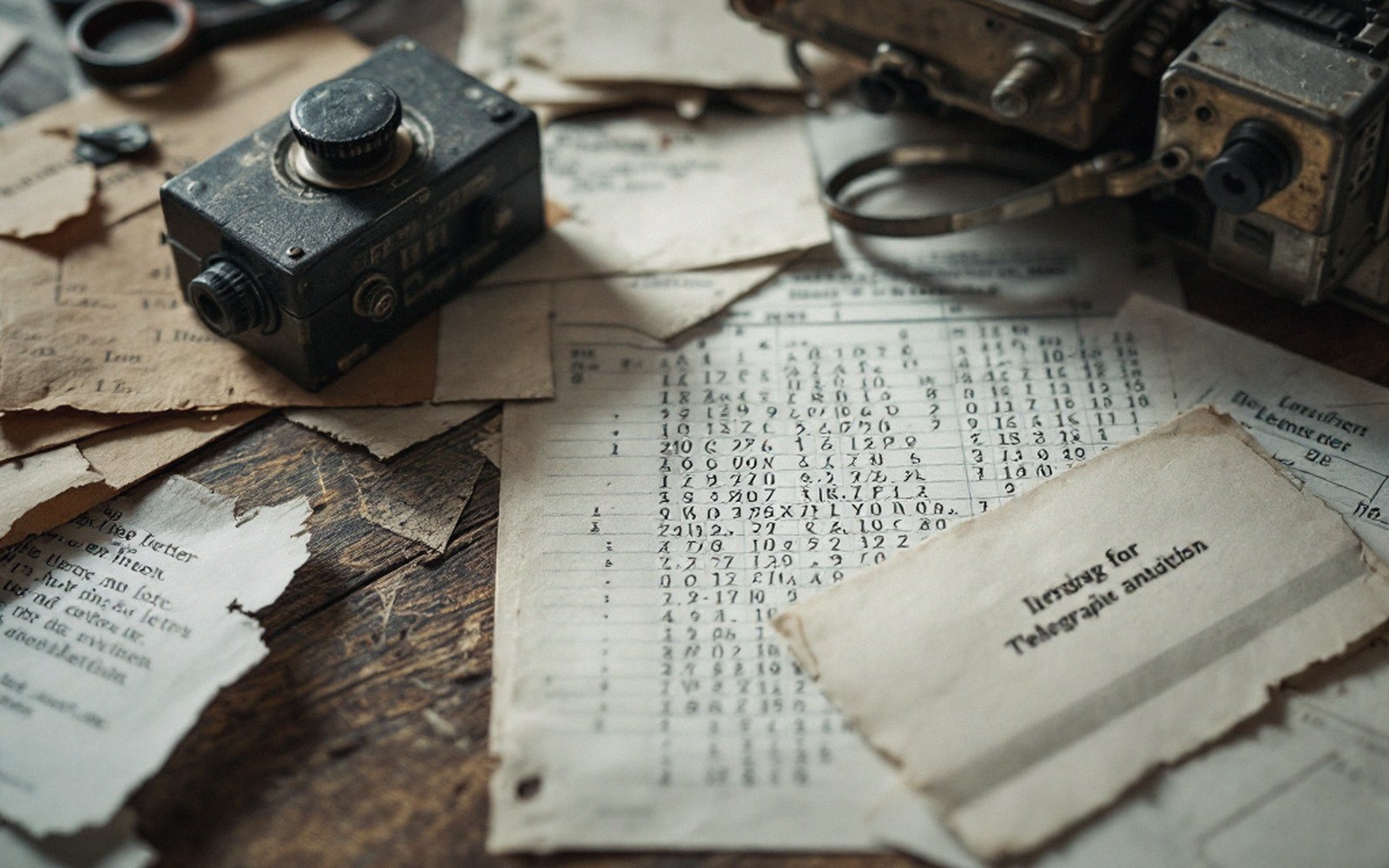
The message you never read
Encryption seals the content of a communication. It does nothing to hide the fact that a communication happened, who sent it, who received it, when, how long it was, or how many others went out at the same time. These bare facts — stripped of any readable word — form a second layer of intelligence that has, in practice, decided campaigns.
The discipline of reading this layer is called traffic analysis, and it predates electronic signals by centuries. A messenger who rides every morning from a provincial governor to the capital tells an observer something whether his saddlebag is locked or not. The frequency of the ride, the urgency of the pace, the number of riders dispatched together: all of it is data.

Radio made the problem acute. From the First World War onward, signals could be intercepted without the sender knowing, and direction-finding equipment could locate a transmitter even when the operator said nothing intelligible. A headquarters that suddenly went silent, a forward unit that began transmitting every thirty minutes, a new call-sign appearing on a frequency assigned to a particular theatre — each was a fact independent of cipher text. German signals intelligence on the Eastern Front mapped Soviet order of battle largely through traffic patterns before any encrypted content was broken. Allied analysts before the Normandy landings tracked the movement and activation of German formations the same way.
The volume of a message carries its own weight. A short encrypted signal might be a routine report; a long burst suggests something that required explaining. A sudden spike in traffic from a previously quiet station often meant a decision had been made, whatever the cipher said. Analysts learned to notice when the pattern changed as much as what the change looked like.
Call signs and routing indicators compounded the problem for cipher users. Even when the cipher was sound, the administrative structure around it — which station addressed which, what format the header took, which relay passed it along — reproduced organisational charts in the clear for anyone patient enough to collect and map traffic over weeks.
The only honest counter-measure was to generate false traffic continuously, padding the real signal volume with dummy messages at a steady rate, so that genuine communications disappeared into noise. This was expensive and was never sustained perfectly. The gaps always showed.

Traffic analysis sits alongside the crib and operator habit as a reminder that the cipher itself is only part of the system, and often not the weakest part. The question an adversary asks is not always "what does this say?" Sometimes it is enough to ask "why is everyone talking at once?"